You may have heard the saying that any publicity is good publicity if you know how to do it right, and it especially holds true when it comes to influencer marketing. In other words, a lot of influencers these days are willing to go to extremes just for a little bit more publicity. Now this might shock you, because a lot of influencers out there seem real and humane, but let me break it to you, almost everything you see when it comes to an influencer’s life online is just brilliant marketing.
Let me talk about one such instance of bad publicity gone amazingly right. Earlier this year in January, Logan Paul, ex-Viner current YouTuber, uploaded a vlog titled, “We found a dead body in the Japanese Suicide Forest…” and although he took the video down later due to backlash, here’s what basically happened in it.
So the Japanese Suicide Forest or the Aokigahara Forest is reportedly one of the top spots in the world for suicide victims. If you have ever watched any of Logan’s videos, you’ll know he will do crazy things for views, like maybe throwing an apple at the wall for no apparent reason. And so, maybe for this very reason, Logan and his team decided to take a walk in the forest, probably hoping to stumble across a suicide victim, camera ready and rolling. Now let me tell you this, the Forest is strictly monitored and tourists are only allowed to follow a clearly demarcated path, which Logan decided to ignore and venture out on his own. And yes, his team did stumble across an unfortunate victim, and this vlog was edited and uploaded the very next day of its happening, with absolutely no respect for this victim, or without understanding the gravity of their discovery (or maybe they did understand it all too well, but lets get back to that in a while).
Its no surprise that this video was instantly demonetized, as Logan mentions in his vlog. Understandably, the Internet was infuriated and disappointed, with Logan receiving a lot of backlash and ‘bad’ publicity for this one vlog. So one might think Logan didn’t make any money off this video and that he only lost popularity. And here’s where things get a little bit more interesting. Here’s an extract from Logan’s first apology on Twitter, uploaded shortly after this whole incident.
“I didn’t do it for views. I get views. I did it because I thought I could make a positive ripple on the Internet, not cause a monsoon of negativity. That’s never the intention. I intended to raise awareness for suicide and suicide prevention and while I thought ‘if this video saves just ONE life, it’ll be worth it,’ I was misguided by shock and awe, as portrayed in the video. I still am.”
Of course, it made me wonder how showing a suicide victim in a totally cordoned off area, with no apparent decency could be a positive ripple on the Internet, but I’ll leave that up for debate.
But first, lets talk about the bucks. According to Forbes, Logan Paul made $12.5 million in 2017. A quarter of his total income comes from ad revenues. Influencers and content creators heavily depend on their content to get them revenue, so lets say that the demonetization of this one video must have affected a quarter of his income for that particular fiscal period. But, Logan also reportedly makes $150,000 per Facebook post, and $80,000 for sponsored content on Instagram. That is LOT of money as part of influencer marketing.
However, due to this vlog Logan uploaded, not only was his income from just the ad revenue gone, but he was also pulled off from a lot of future YouTube projects, which should also heavily affect his publicity and popularity. But here’s where things get a little more interesting.
Despite tweeting apology messages on Twitter, Logan later even uploaded an apology video on YouTube, which reportedly earned him $12,000. Not losing money, is he? Moreover, this bad publicity stunt just got him more views and more bucks. For the next 2 months, countless YouTubers made videos on him, countless articles and posts were written on him, and if you didn’t know who Logan Paul was before this, you certainly do now. Here’s two graphs that show exactly how much Logan Paul has gained, taken from Social Blade.

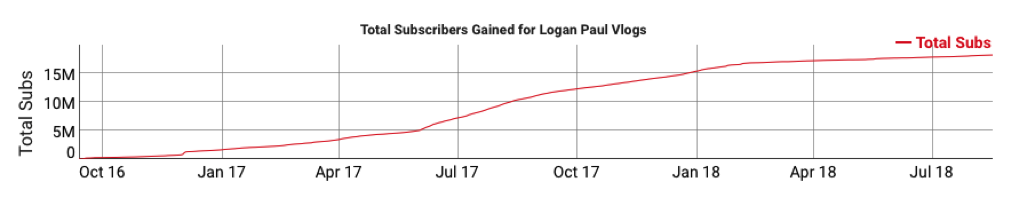
As you can see, the graphs are upward slopes, which means that he ONLY gained popularity, and became more public, despite the whole fiasco. If this isn’t excellent influencer marketing, I don’t know what is.
But talking about just one such influencer to prove a point isn’t enough. Lets take a look at more such people who used the idea of doing anything as long as it got them eyeballs and publicity.
Lil Tay, a nine-year-old girl suddenly emerged with a bang earlier, claiming herself to be the world’s youngest ‘flexer’. Flexing, in social media terms basically means showing off how much you have in monetary and materialistic terms. She appeared in one of RiceGum, another popular YouTuber’s video, “flexing’, and grew in popularity. She currently has over two million followers on Instagram.
Lil Tay would basically go around talking about how wealthy she is, how many cars she owns, how much she ‘grinds’ (lets keep in mind she’s nine) and after watching any of her videos, one might think that this is just an example of upbringing gone terribly wrong. No parent would allow a nine year old to talk like they’re part of some gang nor would a nine year old kid even think of such ideas of showing off. Due to this absurdness, she received a lot of backlash; everyone shared her content basically just to ridicule her. But, the end goal was achieved – she gained publicity.
Another example of bad publicity gone right would be Woah Vicky, an Instagrammer. She is a white teenager claiming to be black. Ridiculous, right? Totally, but its getting her the views just because people like you and me will click on her profile to see exactly how bad it gets.
These are just a few classic instances of influencer marketing using strategies that might sound absurd, but actually work.
Such influencers will generally do whatever it takes just to get views. They probably no how ludicrous or illogical, sometimes even dangerous, their content might be, as in the case of Lele Pons, an influencer who will be seen falling flat on her face in most videos, but they will do these things to achieve their goal that is to be more public. The more people talking about them, the more public they get, the more popularity they receive, and since their livelihoods are totally dependent on this, they are actually succeeding in gaining publicity.
What sells is shocking and fascinating content, people need something to react to, and such influencers will make content that will get the most reactions. They may start as nobodies, but they will quickly gain in popularity as soon as they do something crazy and some other popular influencer out there reacts to it.
In a lot of instances, influencers will also team up to achieve their common goal, which is to gain popularity. You might see this in the form of public fights, which a trained eye will instantly recognize as staged. A lot of times you might find influencers sparking up fights with other influencers, and draw people’s attention to both of them. The audience might think they have bad beef between them when in reality it’s a plan to gain publicity. An example of this would be Logan Paul (hello, again) calling out a fight against KSI on YouTube.
Such influencers will also heavily rely on clickbait to attract viewers, and will often resort to doing dangerous things just to gain publicity. Jake Paul, Logan Paul’s brother, did something similar by setting his empty pool on fire in one of his vlogs. Yes, he actually set it on fire.
We might think the Paul brothers are extremely stupid to be doing such things, but in my opinion, they’re kings of influencer marketing. They’re marketing themselves as guys people will have to watch for just to see what crazy thing they’ll do next.
So based on all of this information, here are a few pointers to help you identify influencer marketing using the ‘bad publicity is good’ strategy-
- Influencers will resort to doing stupid and dangerous things
- They will have click bait titles or screen previews
- They will often spark up controversy, willingly or not
- They will make sure a lot of people are talking about them
- Their followers comprise of young children or critics watching out for their next move
Now these are strategies that influencers use to get more public. But let us briefly touch upon a less noticeable trend as seen on Instagram, used by popular meme accounts, which may also be considered as influencer accounts.
These days, you might find a lot of meme accounts being private. They have massive followings in millions, but strangely enough, they’re all private.
Now you might think, going private, and reducing the accessibility of an Instagram user might actually not work out in their favour, because they’re supposedly adding an extra barrier the user has to cross just to access their content. This is definitely not good publicity as they’re not “public” in the first place. But lets take a look at a few of these accounts.
Pubity, a meme account has 6.6M followers, and is private. Their typical posts include stolen memes and shout outs to other such pages.
Memezar, another private account has 4.6M followers, and their average posts will tell you to go follow these other meme accounts, which are also private. One such post might include a shout out to Pubity, thus creating a closed circle.
Basically, you might notice that such accounts create an illusion of exclusivity, which might look like only a few people are allowed to check out their content, when in reality these “few” people go up to millions in number.
This is just another strategy influencer accounts use where it looks like they’re doing something that will reduce their public presence and popularity, but in fact are achieving the exact opposite effect, that is, gaining publicity.
And let me give you some bad news, unfortunately, this will never stop. Influencers have been using such strategies for influencer marketing since years, and will continue to do so, because ordinary people easily fall victim to their schemes. But the good news is that such influencers die out just as fast as they emerge, because to stay in such a competitive field, one must produce quality content, and stay consistent and true to themselves. Only then will they survive for long.
Basically, the “bad publicity is good publicity” in influencer marketing will definitely work if you do it right, but it is only short term, for more long-term engagement goals, more comprehensive and intelligent plans must be encouraged.
 Hey, I'm Bhavishya
2 thoughts on “What Logan Paul did right.”